
Where the Flowers Sing and the Leaves Dance: On the Soft Fascination with Nature
Poets, authors, and philosophers have long been inspired by nature. Only recently has there been scientific research showing how natural environments heal the body and mind, and uplift our spirits. Our article this month, following the international release of The Science of Flourishing: What Psychological Research Tells Us about Living Well, delves into how a soft fascination with nature benefits our well-being.
EMOTION SCIENCE ARTICLESSUGGESTED READSNEW ARTICLES
Eugene Tee
6 min read
Travels with Mother Nature
If I were to be asked about my favourite perk being an academic, it would be how the role offers a myriad of travel opportunities. The discovery of new knowledge, I realise, happens not just in our research laboratories, but when we venture beyond our ivory towers. I typically travel to where academic conferences are held. And, over the sixteen years as an academic – twenty years, actually, if I count my years as an academic-in-training – I’ve had the chance to travel to learn not just from my collaborators, but also from the places I’ve visited over the years.
The memory of the forest-bathing (shinrin-yoku) experience in Oku-tama in Japan was something I wrote about in The Science of Flourishing. And there have been many occasions, too, where I took at least a day during my conference schedule to immerse myself in natural environments. I took an hour after shopping for souvenirs at Dublin’s Grafton Street to unwind amidst the emerald leaves and unhurried pathways at St Stephen’s Green. My brother and I spent the first day of this year walking through the Sentosa Nature Discovery trail in Singapore, where cicadas joined in our conversation about resolutions. Two years ago, my colleague and I took a day trip to the “Roof of Thailand” – Doi Inthanon National Park, where we were awed by the magnificent stupas and statues of the Buddha amidst a sea of hydrangeas, wild orchids, and rhododendrons. On a solo trip to Perth, I spent a day on beautiful Rottnest – an island 90-minutes by boat from Fremantle, Western Australia. There, I got to meet the friendly islanders – quokkas – possibly the most adorable marsupials in the world – as I strolled along the coastlines that hugged the Indian Ocean, all while listening to the song of the seagulls.
Taking a day to visit these natural surroundings – as far as many of these places may be from home, strangely, did not feel alien to me. Instead, there was a feeling that I was “away from home but feeling at home,” whether I had found myself at a community park, forest trails, or by the sea. There really is no word for this emotion (not that I know of anyway), but it is likely related to the biophilia hypothesis – our natural, human affinity for nature.
A Soft and Gentle Fascination
On any given day, I spend – and perhaps you too – hours in front of our laptop screens working, or on our devices interacting with others. We also spend long hours seated every day. The average adult spends 4.7 hours per day sitting down, and among workers in tech-driven Asian societies, that number jumps to 8.4-8.8 hours daily [1]. An abundance of research evidence shows that being constantly glued to our devices – screen time – is associated with depression, anxiety, and mood disorders, physical hazards such as muscular strains, and a decline in the quality of relationships and cognitive abilities [2]. Screen time is particularly detrimental to children and adolescents. One widely cited study showed that youth who were high screen users were twice as likely to report mental health disorders and show less curiosity, self-control, and emotional stability [3].
You might be expecting to hear that the remedy to our modern-day malady of inactivity is to incorporate more movement into our day. Or to start an exercise habit. And you would be right – partially at least, since we’ve offered similar suggestions in a related article. But what I’ve come to realise as well is that, when it comes to health, our environments matter more than we realised. It not only matters how frequently we engage in exercise, but also where we engage with them as well. Positive psychology research has long focused on the individual and their relationships, on habits, notably. It is only recently that it has expanded to examine how our surroundings also shape our well-being.
Nature is fascinating. In a soft, gentle, and kind way. If you’ve spent time on a forest walk, in the presence of trees, enjoying the sight of flowers, you might have experienced an invitation to simply be. So distant are many of us from the natural environment that we find it unfamiliar to be in and with nature. But on the forest floor or path through our local park, we find ourselves paying a bit more attention to the rhythm of rustling leaves and the chant of birdsong; our attention is gently being drawn into them. We notice the swaying of the branches and blooming flowers amidst the summer breeze, as if they were waving at us in concert. We see thousands of playful ripples on a pond heralding a light springtime shower. We are enticed by the hypnotic tempo of the waves embracing the sheer cliffs by the ocean – as it has done so for thousands of years.
Researchers have termed such expressions of nature ‘soft fascination.’ This is where things in our environment capture our attention without force [4]. Nature’s expressions – much like the ones described above – are examples of soft fascination. They stand in contrast with ‘hard fascination’ – the glare of our screens, the message notifications that break our workflow, the endless stream of social media content that ensnares our attention. Mother Nature invites, technology demands. A line from a character from the classic The Secret Life of Walter Mitty movie captures this sentiment: “Beautiful things don’t ask for attention... If I like a moment, I don’t like to have the distraction of a camera.” Extraordinary places and moments don’t need to cry out to be noticed. Rather, they simply exist, waiting for their perfection to be found.
Nature Restores and Strengthens Us
Scientific studies show a link between our soft fascination with nature and attention restoration theory. The theory suggests that time spent in nature helps us replenish the ability to pay attention [5]. One study involved researchers grouping participants into three different conditions – an office environment, an office with some vegetation (i.e., some exposure to nature), and an indoor environment with a large number of plants and an open view to the sky. Measuring the participants’ brain activation through an electroencephalography (EEG), the researchers found that those immersed in nature showed greater attention and higher working memory performance than the other two conditions [6]. The invitation to be attentive to nature restores our ability to be attentive elsewhere.
Other studies have shown that the presence of indoor plants can restore worker well-being. Plants lower stress and fatigue – evidenced by reductions in systolic blood pressure and heart rates [7]. Another study showed that both indoor plants and guided meditation helped promote affective restoration – improving worker moods during a rest break [8]. These studies complement studies showing how regular exposure to nature enhances the immune system through the activation of Natural Killer cells – a key component of our immune system [9]. The scientific evidence is accumulating in pointing to a simple fact – nature invites, nature heals, and opportunities for long-term flourishing are abundant in natural environments.
Wander Among the Trees
There is a strange kind of excitement experienced after a long-haul flight, the moment one steps out of the plane into a new, unfamiliar city. I enjoy what the French call flaneuring – the art of strolling aimlessly through cities with no destination, to take in the sights, sounds, and experience of being present in a new environment. This has often led me off the beaten path. Away from the glass-paneled skyscrapers that paint the city’s skyline and bustling shopping streets. Far from the convention centers and hotels hosting the conference. Leaving behind steel, concrete, and the sound of traffic, I find myself returning to earth, wood, and the songs of nature. And now I know better why nature is not just good for my health, but for my spirit as well.
When did you last listen to the song of flowers and the trees? When was the last time the rivers, lakes, and oceans sang to you?
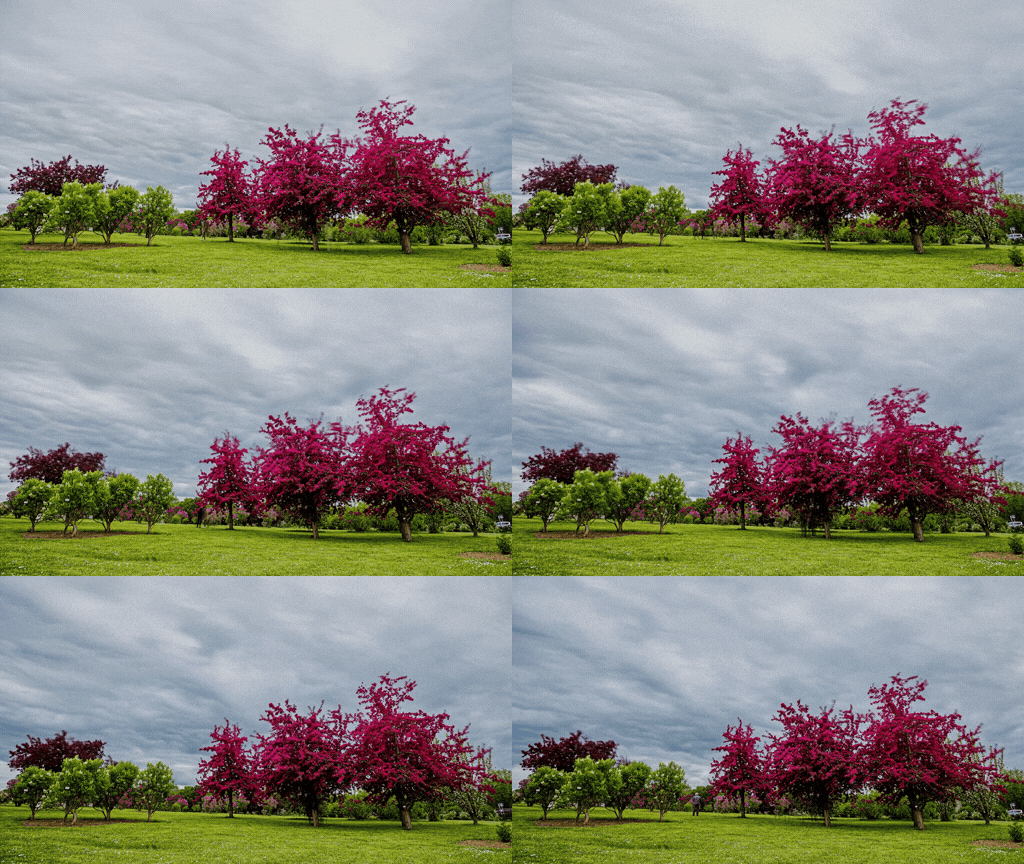
There is pleasure in the pathless woods, there is rapture in the lonely shore, there is society where none intrudes, but the deep sea, and music in its roar.
~ Lord Byron
References
[1] Mclaughlin, M., Atkin, A. J., Starr, L., Hall, A., Wolfenden, L., Sutherland, R., ... & Wijndaele, K. (2020). Worldwide surveillance of self-reported sitting time: a scoping review. International Journal of Behavioral Nutrition and Physical Activity, 17(1), 111. https://doi.org/10.1186/s12966-020-01008-4
[2] Devi, K. A., & Singh, S. K. (2023). The hazards of excessive screen time: Impacts on physical health, mental health, and overall well-being. Journal of Education and Health Promotion, 12(1), 413. https://doi.org/10.4103/jehp.jehp_447_23
[3] Twenge, J. M., & Campbell, W. K. (2018). Associations between screen time and lower psychological well-being among children and adolescents: Evidence from a population-based study. Preventive Medicine Reports, 12, 271-283. https://doi.org/10.1016/j.pmedr.2018.10.003
[4] Basu, A., Duvall, J., & Kaplan, R. (2019). Attention restoration theory: Exploring the role of soft fascination and mental bandwidth. Environment and Behavior, 51(9-10), 1055-1081. https://doi.org/10.1177/0013916518774400
[5] Stevenson, M. P., Schilhab, T., & Bentsen, P. (2018). Attention Restoration Theory II: A systematic review to clarify attention processes affected by exposure to natural environments. Journal of Toxicology and Environmental Health, Part B, 21(4), 227-268. https://doi.org/10.1080/10937404.2018.1505571
[6] Rhee, J. H., Schermer, B., Han, G., Park, S. Y., & Lee, K. H. (2023). Effects of nature on restorative and cognitive benefits in indoor environment. Scientific Reports, 13(1), 13199. https://doi.org/10.1038/s41598-023-40408-x
[7] Zhang, G., Li, T., Cui, Y., & Ren, T. H. (2025). The restorative effects of working individually in a vegetated office space: A crossover controlled experimental study in real-life workplace setting. Work, 81(3), 3070-3082. https://doi.org/10.1177/10519815251323994
[8] Archary, P., & Thatcher, A. (2022). Affective and cognitive restoration: comparing the restorative role of indoor plants and guided meditation. Ergonomics, 65(7), 933-942. https://doi.org/10.1080/00140139.2021.2003873
[9] Lew, T., & Fleming, K. J. (2024). Phytoncides and immunity from forest to facility: A systematic review and meta-analysis. Pharmacological Research-Natural Products, 4, 100061. https://doi.org/10.1016/j.prenap.2024.100061