
Mix, Match, Maximize: Using the Elements Model to Optimize Positive Psychology Interventions
Positive psychology interventions (PPIs) are evidence-based activities that can reliably enhance positive experiences, leading to well-being benefits. Our science article this month looks into the evidence for these interventions and offers some guidelines for you to adjust, adapt, and improvise these activities to boost your well-being and those around you.
EMOTION SCIENCE ARTICLESSUGGESTED READS
Yesterday I was clever, so I wanted to change the world. Today I am wise, so I am changing myself.
- Rumi
References
[1] Meyers, M., Van Woerkom, M., & Bakker, A. B. (2013). The added value of the positive: A literature review of positive psychology interventions in organizations. European Journal of Work and Organizational Psychology, 22(5), 618–632. https://doi.org/10.1080/1359432X.2012.694689
[2] Carr, A., Cullen, K., Keeney, C., Canning, C., Mooney, O., Chinseallaigh, E., & O’Dowd, A. (2021). Effectiveness of positive psychology interventions: a systematic review and meta-analysis. The Journal of Positive Psychology, 16(6), 749-769. https://doi.org/10.1080/17439760.2020.1818807
[3] Chakhssi, F., Kraiss, J. T., Sommers-Spijkerman, M., & Bohlmeijer, E. T. (2018). The effect of positive psychology interventions on well-being and distress in clinical samples with psychiatric or somatic disorders: A systematic review and meta-analysis. BMC Psychiatry, 18, 1-17. https://doi.org/10.1186/s12888-018-1739-2
[4] Chaves, C., Lopez-Gomez, I., Hervas, G. & Vazquez, C. (2016). A comparative study on the efficacy of a positive psychology intervention and a cognitive behavioral therapy for clinical depression. Cognitive Therapy Research, 41, 417–433 (2017). https://doi.org/10.1007/s10608-016-9778-9
[5] White, C. A., Uttl, B., & Holder, M. D. (2019). Meta-analyses of positive psychology interventions: The effects are much smaller than previously reported. PloS One, 14(5), e0216588. https://doi.org/10.1371/journal.pone.0216588
[6] Pawelski, J. O. (2020). The elements model: Toward a new generation of positive psychology interventions. The Journal of Positive Psychology, 15(5), 675-679. https://doi.org/10.1080/17439760.2020.1789710
[7] Sin, N. L., & Lyubomirsky, S. (2009). Enhancing well‐being and alleviating depressive symptoms with positive psychology interventions: A practice‐friendly meta‐analysis. Journal of Clinical Psychology, 65(5), 467-487. https://doi.org/10.1002/jclp.20593
[8] Donaldson, S. I., Lee, J. Y., & Donaldson, S. I. (2019). Evaluating positive psychology interventions at work: A systematic review and meta-analysis. International Journal of Applied Positive Psychology, 4(3), 113-134. https://doi.org/10.1007/s41042-019-00021-8
[9] Hall, G. C. N., Ibaraki, A. Y., Huang, E. R., Marti, C. N., & Stice, E. (2016). A meta-analysis of cultural adaptations of psychological interventions. Behavior Therapy, 47(6), 993-1014. https://doi.org/10.1016/j.beth.2016.09.005
[10] Pedrotti, J. T., Edwards, L. M., & Lopez, S. J. (2009). Positive psychology within a cultural context. In S.J. Lopez & C.R. Snyder (eds.). Oxford handbook of positive psychology, 49-57.
[11] Hendriks, T., Schotanus-Dijkstra, M., Hassankhan, A., De Jong, J., & Bohlmeijer, E. (2020). The efficacy of multi-component positive psychology interventions: A systematic review and meta-analysis of randomized controlled trials. Journal of Happiness Studies, 21(1), 357-390. https://doi.org/10.1007/s10902-019-00082-1
[12] Toepfer, S. M., Cichy, K., & Peters, P. (2012). Letters of gratitude: Further evidence for author benefits. Journal of Happiness Studies, 13, 187-201. https://doi.org/10.1007/s10902-011-9257-7
[13] Tomasulo, D.J. (2019). The Virtual Gratitude Visit (VGV): Using psychodrama and role-playing as a positive intervention. In: Van Zyl, L., Rothmann Sr., S. (eds). Positive psychological intervention design and protocols for multi-cultural contexts. Springer. https://doi.org/10.1007/978-3-030-20020-6_18
[14] Woods, S., Lambert, N., Brown, P., Fincham, F., & May, R. (2015). “I’m so excited for you!” How an enthusiastic responding intervention enhances close relationships. Journal of Social and Personal Relationships, 32(1), 24-40. https://doi.org/10.1177/026540751452354


Positive Psychology Interventions: What Does the Evidence Say?
Positive psychology interventions (PPIs) are intentional activities or methods that identify, build, and/or broaden any aspects of the three pillars of well-being. These pillars typically include positive subjective experience, positive traits, and/or positive institutions [1]. Numerous meta-analyses show that PPIs are effective not just in contributing toward the experience of the positive, but also in reducing the undesired. Carr and colleagues, in a sample of 347 studies comprising more than 72,000 participants, for example, showed that PPIs boosted well-being and were also effective in reducing the effects of depression, anxiety, and stress [2]. Similar reviews using clinical populations also show that PPIs led to significant decreases in depression and anxiety, with one study showing the effects of PPIs held in follow-ups when this population was sampled again from 8 to 12 weeks [3]. The enduring effects of these interventions help broaden the scope of possible treatments for clinical populations. Some studies also show that PPIs can be equally as effective in treating psychological disorders as established clinical approaches such as cognitive behaviour therapy (CBT; [4]). While some reviews indicate that the effects of PPIs are not quite as strong as claimed – what researchers debate here is something called ‘effect sizes,’ the evidence is clear that PPIs do, in effect, work [5]. In short, there is strong evidence that PPIs elevate well-being and that the positive gains from these PPIs are sustained over time.
The Most Effective Interventions are Adapted and Tailored
The philosopher James Pawelski proposes that PPIs are intentional activities for increasing hedonic or eudaimonic well-being [6]. PPIs range include those that help individuals increase gratitude and kindness, to activities that help encourage individuals to cultivate mindfulness or set intrinsically motivating goals [7]. For organizations, PPIs can be designed to help individuals recognize their psychological capital (PsyCap) and strengths, and encourage employees to modify certain aspects of their job to maximize their productivity and well-being (a process called job crafting). Studies also indicate that these organizational PPIs are effective and beneficial [8]. The popularity of PPIs is also apparent in positive psychology books written for the general population, such as Sonya Lyubomirsky’s The How of Happiness and Barbara Fredrickson’s Positivity.
Pawelski, however, contends that, given the popularity and effectiveness of these interventions, there could be more of them. He proposes that positive psychology practitioners and informed readers in the field might be able to create new PPIs – tailoring and suiting them for their specific circumstances and contexts. The importance of adapting and tailoring interventions is also evidenced in the literature. When psychological interventions are adjusted to match and suit the cultural context in which they are introduced, the intervention is oftentimes more effective than unadjusted or updated versions of the interventions [9]. Positive psychology practitioners have also heeded such recommendations and acknowledge the importance of such adaptations to align with the specific challenges of the target population, and their unique cultural context, with the intervention that is most likely to bring well-being benefits to them [10].
The Elements Model
Pawelski (2020) proposes a way in which PPIs can be tailored, adjusted – in effect, mixed and matched to maximize their effectiveness for the target population. In his elements model, he offers a way to understand the ‘building blocks’ of a PPI. The elements model comprises five elements, detailed in the table below:
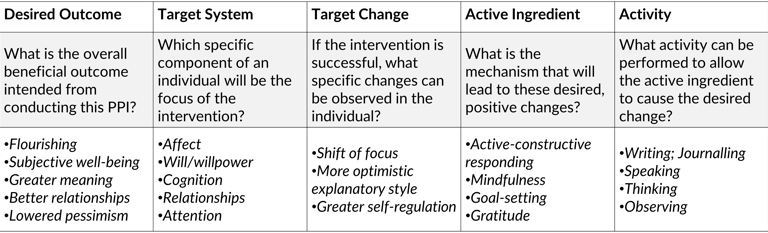
Seen this way, PPIs can be understood in terms of their ‘constituent elements’ and their components adjusted, changed, swapped out, and adapted to suit the target population’s needs and well-being goals. The elements model can also be used to create multi-component PPIs – “interventions that contain a variety of evidence-based individual exercises targeting two or more theoretically relevant hedonic and eudaimonic well-being components into an integral program” [11]. The classic ‘gratitude letter’ writing intervention [12], for instance, might be paired with a gratitude to visit [13], which will likely be more effective than relying on a single intervention alone.
If you are interested in using the elements model to guide the design of your intervention, you can refer to the elements model and decide which components (i.e., which building block) you would adapt to better fit your circumstances and context.
Let’s say your desired outcome would be to better your relationships with others (Desired outcome = better relationships).
This would mean that you might target relationships – in this case the specific relationship with your spouse as the system of interest for your intervention (Target system = relationship with spouse).
What might be a good indication that the intervention is beneficial and working as intended? You might think that perhaps your partner will be more responsive toward, open to, and receptive toward you when you next interact with them (target change = greater partner responsiveness). Alternatively, you might want to consider a more mindful approach to your interactions. You might have realized that your partner is reluctant to share good news with you since you repeatedly interrupt them when they do so. In this case, the intended change may be greater partner comfort and vulnerability in sharing the good news with you (target change = greater partner openness).
You can then think of the specific active ingredient – the exact mechanism that leads to this desirable outcome. What might be the reason leading your partner to be more responsive and willing to share their experiences with you? A popular and also well-evidenced approach would be to capitalize – celebrate good news whenever your partner shares it with you. You then make the effort to respond openly, kindly, and enthusiastically the next time your partner shares the good news with you. This approach is known as active-constructive responding ([14]; active ingredient = active constructive responding). The active ingredient might also include mindful speech and listening (active ingredient = mindful speech/listening) to encourage open and respectful sharing between you and your partner.
Finally, the specific activity you might want to engage in as part of this intervention would be to interact with your partner in a certain way. Here, you might incorporate mindful speaking and listening in your interactions with them in the future – more so when they relay good news to you (activity = speaking/listening).
There are numerous opportunities and possibilities for PPIs to benefit your well-being, and generating new interventions for following the elements model is a good way to start thinking up unique interventions – for yourself or those around you. Or better still, interventions that benefit both you and those around you. The ideas and possibilities are endless, and your options will only increase as the science grows and offers more evidence for the well-being benefits of PPIs.