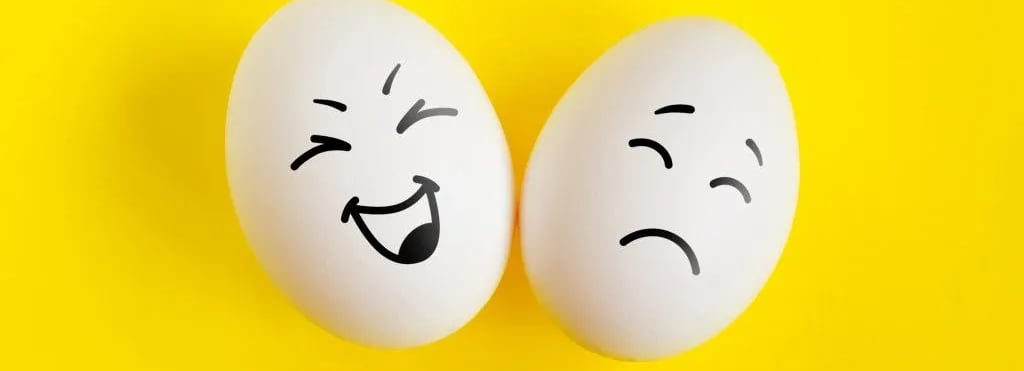
Schadenfreude: One Man’s Pain is Another Man’s Pleasure
A person you envy, or dislike immensely experiences a misfortune. “They had it coming,” you say – but it’s not that you are a bad person. It just feels nice that this terrible person finally experiences some deserving misery. Read Raja Intan Arifah’s insightful article on the emotion that we all experience but are unwilling to admit to feeling – schadenfreude.
EMOTION SCIENCE ARTICLESGUEST ARTICLESSUGGESTED READS
Our guest writer for this article is Raja Intan Arifah binti Raja Reza Shah.
Ten seconds remain at the end of extra time at a tense football match. You clench your fist awaiting the final whistle. Ten seconds – that’s all that stands in the way of your team being crowned champions. You are glued to the screen watching as your team’s defenders scramble to defend its goalmouth. Any slip-up now would be costly. The commentator suddenly raises his voice, alerting you to a careless mistake from one of your team’s defenders. “Wait a minute, a mistake from the defender – a golden opportunity now – he shoots…and MISSES!” The whistle goes off, and your team wins the cup. The rival team’s players slump to the ground, holding their hands to their faces, knowing they were so close to snatching victory in the final seconds. The commentator highlights the missed chance, and, while you feel relief – you cannot help but feel another emotion. A tinge of glee bubbling up from within, your eyes gleaming at your team’s victory, coupled with a wry smile from seeing the dejection on the faces of the rival team’s players. The English language is silent on such an emotion – but the Germans have a word for it: Schadenfreude.
What is Schadenfreude?
Schadenfreude comes from the combination of two words; “schaden” meaning “harm,” and “freude” meaning “joy.” Put together, the words refers to that joyful feeling experienced when another suffers a misfortune [1]. Cultural historian Tiffany Watt Smith, author of Schadenfreude: The Joy of Another’s Misfortune, traces the roots of this emotion to more than two millennia ago, when the Romans spoke of malevolentia. The Greeks described it as epichairekakia (“epi” which means “over,” “chairo” which means “rejoice,” and “kakia” which means “disgrace”). The French call it joie maligne, in Danish, skadefryd, and in Dutch, it is leedvermaak. Non-Western civilizations too, have a term for this emotion. In Mandarin Chinese, it is 幸灾乐祸 (pronounced xìng-zāi-lè-huò) and among the Melanesians of Nissan Atoll in Papua New Guinea, it is banbanam. In Hebrew, taking delight in another’s misfortune is simcha la-ed, in Serbo-Croat it is zlùradōst and in Russian, zloradstvo [2].
Although many languages have a specific word for joy at the misfortunes of others, there are also many languages that do not have a direct translation for this emotion. Does this communicate significant information about the prevalence of schadenfreude in different cultures? Probably not [3]. Culture and language may help define the experiences we use to make sense of the world around us. They also influence the way we communicate our experiences to one another. Our emotion lexicon, however, is not always an accurate indicator of whether individuals can experience a specific emotion. Even members of societies whose language does not have a word for schadenfreude will still be able to understand the term once you explain the context to them [4].
Regardless of the language used, schadenfreude (and its other cultural variants) is felt when a third party or circumstances bring about misfortune to a disliked or envied other. It is different from feelings of victorious joy or gloating [5]. Schadenfreude is the joy experienced from another’s mishap; the emotion does not elicit the desire to inflict extreme harm on others. As such, it is further distinguished from sadism, which involves directly causing the misfortune or inflicting pain to the other [6]. Schadenfreude, in contrast, involves the passive observation of another’s misfortune.
Why Do We Feel Schadenfreude?
Don’t worry – it’s not because you are a bad or evil person. Throughout history, however, philosophers such as Aristotle, Schopenhauer, Kiekergard and Heider detested schadenfreude, describing it as an expression of aggression, a moral failing, an unpleasant cousin to envy and ultimately, damaging to social relations [2]. These moral critiques have raised the question of why we take pleasure in another’s misfortune – sometimes even a little too easily. Research has found that schadenfreude commonly arises under these three circumstances; self-enhancement, deservingness and envy [3]. Self-enhancement underlies the experience of schadenfreude as the misfortune of others may be appraised as an opportunity to enhance or protect a positive view of one’s self. As individuals have a strong need for positive self-evaluation, one way to go about achieving this need would be to compare one’s self to the less fortunate other. Admit it. Looking at another person’s suffering or misfortune can make you own miseries seem less tragic.
Schadenfreude also stems from deservingness. At times, the misfortunes suffered by others satisfy our sense and desire for justice. Although many individuals may feel uncomfortable admitting feelings of schadenfreude, some just desserts seem deserved, prompting individuals to further express this emotion. Envy, in contrast, stems from the appraisal that the other person possesses something that one desires but is unable to obtain. When misfortune befalls the envied person, the negative comparison that was initially experienced dissipates – resulting in feelings of relief and joy. With schadenfreude, it is always personal [3].
Researchers who study schadenfreude have also uncovered that this emotion is traceable to brain activity. Researcher Hidehiko Takahashi and colleagues, for instance, found that schadenfreude activates the ventral striatum – the part of the brain linked with pleasure and assessment of rewards. Similarly, another study by Mina Cikara and colleagues examined schadenfreude between fans of rivalling sports teams – between Red Sox and Yankees fans. Their study provided support for Takahashi and colleagues’ study – fans showed increased activation in the ventral striatum not only when their team won, but also when the rival team lost [9]. And why do we still experience this emotion today? From an evolutionary perspective, schadenfreude might be a natural product of competition over limited resources. As our ancestors inhabited groups and lived in competitive environments where they fought over resources and mates, this emotion may simply be a natural response towards to rewards and losses experienced in such environments [1],[10].
Schadenfreude, Then and Now
Schadenfreude’s first appearance in the English writing was back in 1853, when Richard Chenevix Trench’s published On the Study of Words. In 1895, schadenfreude was included as an entry in the Oxford English Dictionary for the first time. By the late 1980s, there was a notable increase in the use of the word in published books [1],[3]. In recent years, tabloids have relied on people’s fascination with public failures. The cover pages of magazines often portray stories of celebrity break-ups, scandals, unflattering appearances, and other personal tragedies. Schadenfreude is the quintessential emotion of celebrity culture; it complements the guilty pleasure we experience when someone who has so much more than us also falls, fails and suffers like the common man or woman. Try searching for schadenfreude on Google and you will find that the growing interest and attention on this emotion is not just limited to the field of psychology, but also in neuroscience, philosophy and management studies.
The rise of schadenfreude in recent years could be also be due to the importance of understanding this emotion, informing the debate on whether schadenfreude is morally good or bad. There are two ways to view the moral nature of schadenfreude – the first being the motive underlying the experience of schadenfreude and second, being the social implications of schadenfreude [3]. It is important to note that schadenfreude alone is not worrying, but what becomes dangerous is what it can potentially turn into [9]. The discussion on the moral evaluation of schadenfreude would probably continue for years to come. However, what we know so far is that schadenfreude is a natural and common human emotion that is worth a closer look at. And this is because this emotion says something about our status-consciousness nature, reflecting a side of our human nature we rather not let others know about.
References
[1] Smith, R.H. (2013). The joy of pain: Schadenfreude and the dark side of human nature. New York: Oxford University Press.
[2] Smith, T. W. (2018). Schadenfreude: The joy of another’s misfortune. London: Wellcome Collection.
[3] Van Dijk, W., & Ouwerkerk, J. (2014). Schadenfreude. In W. Van Dijk & J. Ouwerkerk (Eds.), Schadenfreude: Understanding pleasure at the misfortune of others (pp. 1-13). Cambridge: Cambridge University Press.
[4] Shiota, M. N., & Kalat, J. W. (2011). Emotion (2nd ed.). CA: Wadsworth.
[5] Leach, C. W., Spears, R., Branscombe, N. R., & Doosje, B. (2003). Malicious pleasure: Schadenfreude at the suffering of another group. Journal of Personality and Social Psychology, 84(5), 932-943. https://www.doi.org/10.1037/0022-3514.84.5.932
[6] Dasborough, M., & Harvey, P. (2017). Schadenfreude: The (not so) secret joy of another’s misfortune. Journal of Business Ethics, 141(4), 693-707. https://doi.org/10.1007/s10551-016-3060-7
[7] Porter, S., Bhanwer, A., Woodworth, M., & Black, P. J. (2014). Soldiers of misfortune: An examination of the Dark Triad and the experience of schadenfreude. Personality and Individual Differences, 67, 64–68. https://doi.org/10.1016/j.paid.2013.11.014
[8] Takahashi, H., Kato, M., Matsuura, M., Mobbs, D., Suhara, T., & Okubo, Y. (2009). When your gain is my pain and your pain is my gain: Neural correlates of envy and schadenfreude. Science, 323(5916), 937-939. https://doi.org/10.1126/science.1165604
[9] Cikara, M., Botvinick, M. M., & Fiske, S. T. (2011). Us versus them: Social identity shapes neural responses to intergroup competition and harm. Psychological Science, 22(3), 306-313. https://doi.org/10.1177/0956797610397667
[10] Anthes, E. (2010). Their pain, our gain. Scientific American Mind, 21(5), 38-41. https://www.jstor.org/stable/24943176