Just What the Doctor Ordered: Art for Well-Being
Art is one of humanity’s oldest forms of creative expression. Recently, researchers have started to examine how museum visits can have a therapeutic effect on our well-being. Our emotion science article here is the first of a three-part series on how human culture – art, music, and literature, can help enrich our emotional experiences and lead to better well-being. In this article, we focus on visual art. What is it about art and the emotions we experience from viewing art, that help enhance our well-being?
EMOTION SCIENCE ARTICLESSUGGESTED READS
A Prescription for Museum Visits
A visit to the art museum conjures up a diverse range of experiences and emotions. For some, it might evoke excitement; for others, disinterest. During the visit, you may feel inspired by certain pieces. Glancing over, however, your experience is contrasted with that of other visitors, who are left expressing visible confusion from the dizzying array of artworks on display. At the end of the trip, you leave the museum feeling transformed – or, perhaps, unsure what the fuss or point of the entire experience was about. No two individuals experience an art museum, nor engage with art in the same way. Yet, recent research evidence suggests that when museum visits are properly designed, art can have a therapeutic effect. Engaging with art – with gentle, instructive guidance, can be good for our well-being. The positive effects on our emotional and psychological health are noteworthy, so much so that doctors in Belgium and Canada have prescribed museum visits to help patients recover from the long-term stress effects of the COVID-19 pandemic [1]
We have created art far longer than we have formally recorded our human story in writing. The earliest art forms can be traced back to more than 73,000 years ago – before the invention of writing [2]. It is only recently, however, that researchers have begun to examine the psychological effects of engaging with art. Whether we view or create art, studies show that it can have a beneficial effect on our well-being. When people visit the art museum, they may experience a sense of immersion, enlightenment, or cheerfulness – all of which can enhance their psychological well-being [4]. Another study showed that combining the viewing experience with allowing visitors to create art also led to increased well-being [5]. This ‘museum effect’ has been the subject of recent research in the positive humanities – a field that studies how expressions of human culture can beneficially affect well-being [6]. Art, being one such reflection of human culture, can be a pathway to well-being.
Of course, not all works of art will necessarily elicit pleasant emotional states. If you’ve visited an art museum before and vowed after, to never go back, it might be helpful to think about why this was the case. Similarly, if you’ve tried your hand at any form of art creation before and were left feeling frustrated by the experience, it would help to understand why. Central to this are the emotions we feel – or importantly, expect to feel when we engage in art. In a survey of art museum professionals, art museum visits have been found to also elicit unpleasant emotions such as anxiety or loneliness [7]. You might think about art pieces that, instead of eliciting inspiration or awe, caused you to feel repulsed, fearful, or even disgusted. At best, they leave you feeling bored, or confused. The range of emotions – both pleasant and unpleasant that you feel from engaging in art has a name. They are known simply as aesthetic emotions – a family of emotions roused from engaging with art [8].
Engaging with Art and Aesthetic Emotions for Well-being
Fortunately, the research also tells us we can engage with art in a way that will be healthy for our well-being. To do so, it first helps to think about our visits to art museums as environments that allow us to safely experience a wide range of emotions. So, you might think of your visit as akin to an opportunity for you to experience – experiment, even, with the rich tapestry of feelings without risking long-term effects on your well-being. The unpleasant emotions you experience in response to art are temporary – and, crucially, a safe opportunity for you to reflect, contemplate, and better understand the experience of those subjectively unpleasant feeling states. Museum guides can be helpful in this regard, offering insightful and informative explanations for the art piece, thereby helping you appreciate the artwork and your emotions in the context and time in which the artwork was created. Such guidance can make the museum visit a holistic and enriching experience that encompasses both positive and negative emotions [9].
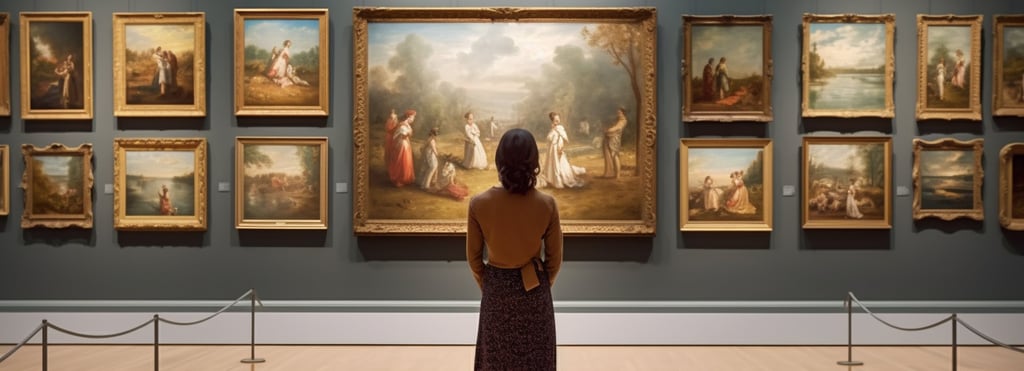
You can also practice mindfully engaging with art, which can be beneficial for your well-being. The next time you visit the art museum, slow down and savour the experience. Often, it is easy to glance at an artwork, and then move on to the next piece on display without fully engaging with it. Try what author Shari Tishman calls ‘slow looking’ – looking at art for a longer period, observing it, and allowing for new insights to emerge [10]. Take a slow approach to art. Allow for new observations and realizations to emerge from your viewing. Perhaps you spot details on a painting that were not immediately obvious at first glance. Perhaps there was a feature of a sculpture that eluded your sight until you paused to view it more deliberately. Perhaps, a new story emerges from your initial viewing of an oil painting, giving you glimpses of the artist’s emotions when they created the piece. Mindfully viewing and engaging in art can be good for you. Studies show that mindfully engaging with art can elicit more positive experiences and enhance psychological flexibility – you learn to see the world more openly and non-judgmentally [11].
The next time you take a trip to the art museum, recognize that it offers an opportunity for you to be self-aware of, experience, and contemplate a wide range of emotions that can enhance your well-being. There are arguably fewer places than the art museum or the humble art gallery that offers such an opportunity. Art is a reflection of the kaleidoscope of human feeling states, a glimpse into the emotions of the artists that created them, and a chance to share in the common human experience of how the emotions in art move, transform, and change you and the artist.
References:
[1] Amsen, E. (2021). What do we know about doctor-prescribed museum visits? Available at: https://www.forbes.com/sites/evaamsen/2021/10/19/what-do-we-know-about-doctor-prescribed-museum-visits/?sh=199b5e4a247c
[2] Henshilwood, C. S., d’Errico, F., Van Niekerk, K. L., Dayet, L., Queffelec, A., & Pollarolo, L. (2018). An abstract drawing from the 73,000-year-old levels at Blombos Cave, South Africa. Nature, 562(7725), 115-118. https://doi.org/10.1038/s41586-018-0514-3
[4] Thomson, L. J., Lockyer, B., Camic, P. M., & Chatterjee, H. J. (2018). Effects of a museum-based social prescription intervention on quantitative measures of psychological well-being in older adults. Perspectives in Public Health, 138(1), 28-38. https://doi.org/10.1177/1757913917737563
[5] Bennington, R., Backos, A., Harrison, J., Reader, A. E., & Carolan, R. (2016). Art therapy in art museums: Promoting social connectedness and psychological well-being of older adults. The Arts in Psychotherapy, 49, 34-43. https://doi.org/10.1016/j.aip.2016.05.013
[6] Pawelski, J. (2022). The positive humanities: culture and human flourishing. In L. Tay & J.O. Pawelski (eds.). The Oxford handbook of the positive humanities (pp. 17-42). https://doi.org/10.1093/oxfordhb/9780190064570.013.43
[7] Cotter, K. N., Crone, D. L., & Pawelski, J. O. (2023). Flourishing aims of art museums: A survey of art museum professionals. Empirical Studies of the Arts, 41(1), 52-79. https://doi.org/10.1177/02762374221118528
[8] Menninghaus, W., Wagner, V., Wassiliwizky, E., Schindler, I., Hanich, J., Jacobsen, T., & Koelsch, S. (2019). What are aesthetic emotions? Psychological Review, 126(2), 171-195. https://doi.org/10.1037/rev0000135
[9] Rodriguez, R. M., Fekete, A., Silvia, P. J., & Cotter, K. N. (2021). The art of feeling different: Exploring the diversity of emotions experienced during an art museum visit. Psychology of Aesthetics, Creativity, and the Arts. Advance online publication. https://doi.org/10.1037/aca0000443
[10] Tishman, S. (2017). Slow looking: The art and practice of learning through observation. Routledge.
[11] Langer, Á. I., Schmidt, C., & Krogh, E. (2017). Mindfulness meditation and the perception of beauty: Implications for an ecological well-being. In M.P. Levine (Ed.). Perception of Beauty. Intech Open. (pp. 207-223).