
From Vices to Virtues: The Golden Mean of Character Strengths
Character strengths are the best aspects of our personality. These strengths are inherent virtues we express across different situations and in varying degrees. How often do you use your strengths optimally, however? Are you mindful of when you might be over, or under-using your best qualities? Our science article this month explores the optimal use of one’s strengths, following Aristotle’s principle of the golden mean.
EMOTION SCIENCE ARTICLESSUGGESTED READS
Virtue is the golden mean between two vices, the one of excess and the other of deficiency.
- Aristotle
References
[1] Niemiec, R. (2024) Mindfulness and character strengths: A practitioner’s guide to MBSP. Hogrefe.
[2] Smith, B. W., Ford, C. G., Erickson, K., & Guzman, A. (2021). The effects of a character strength focused positive psychology course on undergraduate happiness and well-being. Journal of Happiness Studies, 22, 343-362. https://doi.org/10.1007/s10902-020-00233-9
[3] McGrath, R. E. (2015). Character strengths in 75 nations: An update. The Journal of Positive Psychology, 10(1), 41-52. https://doi.org/10.1080/17439760.2014.888580
[4] Zhu, Q., Wang, Q., & Yang, S. (2024). Does mindfulness matter in the development of character strengths? A RCT study comparing mindfulness-based strengths practice and character strengths-based intervention. The Journal of Positive Psychology, 19(5), 900-921. https://www.tandfonline.com/doi/abs/10.1080/17439760.2023.2257678
[5] Kulandaiammal, R., Hebert, H. S., Alafia, J., & Neelakantan, M. (2024). Mindfulness-based strengths practice: a conceptual framework and empirical review of the literature. International Journal of Mental Health, 1-36. https://doi.org/10.1080/00207411.2024.2348763
[6] Niemiec, R. M. (2019). Finding the golden mean: The overuse, underuse, and optimal use of character strengths. Counselling Psychology Quarterly, 32(3-4), 453-471. https://doi.org/10.1080/09515070.2019.1617674
[7] Baer, R. (2015). Ethics, values, virtues, and character strengths in mindfulness-based interventions: A psychological science perspective. Mindfulness, 6, 956-969. https://doi.org/10.1007/s12671-015-0419-2
[8] McGrath, R. E., Niemiec, R. M., & Westrich, B. (2025). The Golden Mean Inventory: A new approach to studying character strengths imbalances across contexts. Personality and Individual Differences, 234, 112951. https://doi.org/10.1016/j.paid.2024.112951
[9] Niemiec, R. M., & Pearce, R. (2021). The practice of character strengths: Unifying definitions, principles, and exploration of what’s soaring, emerging, and ripe with potential in science and in practice. Frontiers in Psychology, 11, 590220. https://doi.org/10.3389/fpsyg.2020.590220


Character Strengths and the Golden Mean
Character strengths are the best aspects of our personality. These strengths form the virtuous part of our identities. They are, in essence, the best of who we already are. Research on character strengths shows that using these best qualities contributes positive outcomes to both the individual and those around them [1]. Learning about character strengths in formal classroom settings also leads to improved well-being – greater happiness and lowered negative emotion, in particular [2]. Arguably the most widely applicable categorization of strengths, the VIA typology, lists 24 strengths that are universal and valued across different cultures [3]. These strengths are grouped into six virtue categories: (i) wisdom and creativity, (ii) courage, (iii) humanity, (iv) justice, (v) temperance, and (vi) transcendence.
You may already be aware of your best qualities – your virtues (If not, you can take the VIA survey and get a free report here). If so, you may also already be aware of how to ‘see’ strengths – you are mindful of them. You can spot, provide evidence for, and appreciate the strengths in yourself and others, something we covered here. Being mindful of our best qualities and how we are expressing them has consistently been shown to lead to positive well-being outcomes [4]. The integrated practice of mindfulness and character strengths in practices such as Mindfulness-Based Character Strengths (MBSP) has also been found to promote engagement, life satisfaction, and mental health [5].
Yet, even with the recognition of strengths, we may not always be aware of the extent to which we are using them optimally. This optimal use of our strengths is often associated with the principle of the golden mean – an idea that has been explored in both Western and Eastern philosophies. Aristotle described the principle in The Nicomachean Ethics, while in Buddhism, the Middle Way is a spiritual practice that encourages followers to avoid the extremes of asceticism and sensual indulgence [6]. Following the same logic, we too, can find ourselves in situations where we don’t always make optimal use of our strengths. Without mindful recognition of the optimal use of our strengths, we may end up underusing our strengths – we end up not calling forth strengths when we can or when they are most needed. Conversely, we may overuse our strengths – we end up expressing too much of a good thing [7]. Neither is likely to result in optimal outcomes for ourselves and those around us.
Overusing and Underusing Your Strengths
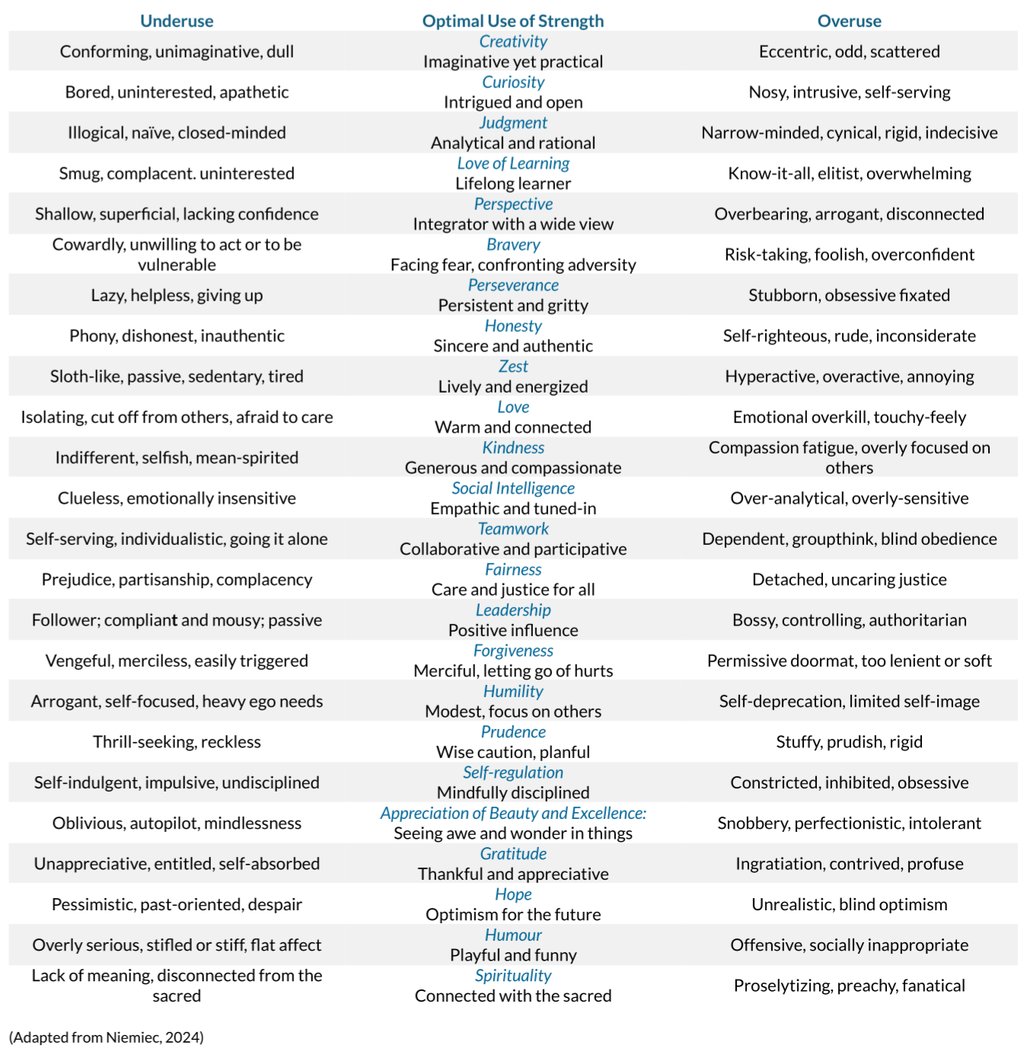
Are you mindful of when you might be over or under-using your strengths? As much as these strengths are essential, energizing and can be used effortlessly, it helps to also note when you might be overly relying on them. The idea of the Golden Mean has recently been applied to our understanding of how even our best qualities – our strengths, can be under or over-used [8]. While underusing strengths may be more common due to blindness, it also pays to be aware of when we might be calling forth on our best qualities to the detriment of our, and other’s well-being.
Let’s say one of your top strengths is honesty – you are sincere, speak without pretence, and are seen by others as genuine and authentic. Under-using this strength may lead you to be seen as inauthentic, insincere, or lacking in integrity. An overuse of honesty, however, might present you as someone inconsiderate, rude, or self-righteous. Similarly, you might be able to think of someone who uses their curiosity well. They are open-minded and receptive to new ideas, and this helps them with their learning or problem-solving. But taken to extremes, such as person could also be seen as nosy, intrusive, or even self-serving. Here’s a list of the 24 VIA character strengths and how they might be over-, or under-used:
Optimizing Your Strengths Use
What might you do to optimize the use of your strengths? For a start, consider your highest strengths – your signature strengths, and consider situations in which you are likely to overuse them. Could you sometimes be too honest, overusing this strength when certain conversations call for more tact and restraint? Or perhaps you tend to underuse or downplay your strength of bravery in situations where you are pressured to consider an unethical course of action. Reflecting on the situations in which your strengths are under-used or over-used can help you determine what could be a more optimal use of your best qualities.
Another approach would be to think about ways in which you can use strengths in tandem with one another. Using the same example, you might want to use your strength of honesty – one of your higher strengths, to ‘boost’ your strength of bravery – one of your lower strengths. This may then encourage you to speak your mind when asked to consider the unethical course of action. This use of higher strengths to bolster and boost one of your lower strengths is referred to as the ‘tempering’ effect [9]. Similarly, you can use your lesser strengths to boost your higher-level strength. Using the same example, consider how you might use your bravery to boost your honesty – calling on your bravery to share your concerns about the course of action you have been asked to take. We all have innate positive qualities that provide us with countless opportunities to do well – both for ourselves and others. The Roman poet Horace reminds us, “Whoever cultivates the golden mean avoids both the poverty of a hovel and the envy of a palace.” He could very well have been referring to the optimal use of humility in this quote. The golden mean helps us refine the use of our best qualities so that we don’t under- or overuse them, ultimately paving the pathways for us to enhance both our well-being and our well-doing.